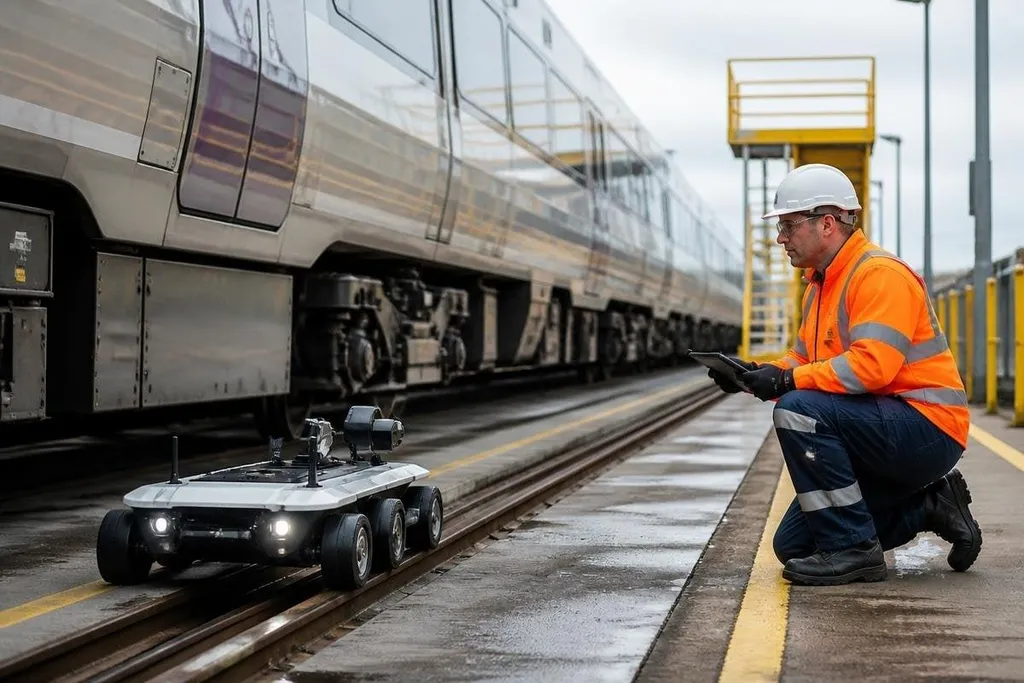
Railway maintenance robots can inspect train roofs, scan wheels, check track, and send faults to a human team. They place sensors beside parts that are hard, slow, or risky to reach by hand.
For a maintenance manager, the useful question is practical: which jobs can a robot check well enough to help a crew make a safer repair decision?
- Inspection range: Robots can examine wheels, axles, brakes, roofs, and track without sending a person into every inspection position.
- Useful sensors: Cameras, LiDAR, thermal cameras, and ultrasonic probes each find different faults.
- Human control: Crews still decide whether a fault needs repair, removal, or another check.
Where railway robots do the work
Depending on the job, the robot may run along a depot floor, attach to a train, move beside track, or inspect parts from a fixed position. The shape depends on the job.
A small crawler can reach under a carriage, while a camera system mounted near the track can watch every wheel that passes.
Wheel inspection is a clear use case. Cameras can record wheel shape and surface damage, while laser sensors measure the wheel profile. That profile shows how much metal has worn away and whether the wheel still matches its required shape. A crew can then send the train to a repair bay with a specific reason.
Roof inspection needs a different setup. For roof work, a robot or sensor unit can check pantographs, roof equipment, cables, and insulators from a safe position. Thermal cameras can show hot spots that a normal camera may miss, though a hot area still needs a technician to find the cause.
The sensors decide what the robot can find
Sensor quality sets the limit. LiDAR measures distance with laser pulses, so it can build a 3D view of trackside objects or train surfaces. Standard cameras record cracks, missing parts, loose fasteners, and stains when lighting is good.
Ultrasonic testing sends sound through metal. Reflections can point to faults below the surface, including defects that a camera cannot see. That makes ultrasonic equipment useful for axles, rails, and other metal parts, but the results need trained review because surface shape and material condition affect the reading.
The data then moves into a maintenance record. A useful system links an image or scan to a train number, a part location, and the inspection time. Without that link, a large folder of images creates more work rather than less.
A dated report on railway inspection robots can tie a machine’s finding to the train, fault, test site, and inspection date. That record gives a maintenance manager something to check before approving a repair.
What changes for maintenance crews
The first change is the timing of inspections. A robot can repeat the same scan after a set number of trips, after a repair, or when a sensor flags a fault. Repeated measurements help a team see wear over time instead of relying on one inspection record.
The second change is task allocation. Inspection robots can collect images and measurements while a technician spends time on diagnosis and repair. That only works when the system marks uncertain cases for review instead of treating every unusual reading as a failed part.
Safety also matters. Work near live railway equipment, moving trains, height, and confined spaces carries real hazards. Remote inspection can reduce how often people enter those positions, but the robot itself needs clear stop rules, reliable communications, and a safe recovery plan when it loses power or contact.
I’d trust railway robots first as repeatable inspection tools, not as automatic repair crews. Finding a worn wheel is one task; deciding whether it can run safely for another service period is a different one.
What still needs proof
Public demonstrations often show a robot completing one clean scan. A railway operator needs more than that. The system must work in rain, dust, poor light, vibration, and crowded depots, then produce records that fit existing maintenance rules.
The cost also includes installation, sensor checks, software updates, staff training, and parts. A low purchase price can lose its value if a team must review every image by hand or call the maker for each fault.
Before a purchase, check these points:
- Name the fault: Decide which defect the robot must find and how a person confirms it.
- Set the work area: Record track access, train speed, lighting, weather, and safe stopping space.
- Check the data: Confirm that each scan links to the train, part, time, and inspection result.
- Test failure handling: See what happens after a lost signal, blocked path, low battery, or bad sensor reading.
- Price the full service: Include training, calibration, software, repairs, and review time.
Railway robots will change maintenance first where the task repeats and the measurement is clear. The next useful proof is not a smoother demonstration; it is a full maintenance period showing how many faults the system finds, how many false alarms it creates, and how much crew time remains after review.